
Top 12 Workplace safety training courses
Published
December 1, 2025
Author
Share

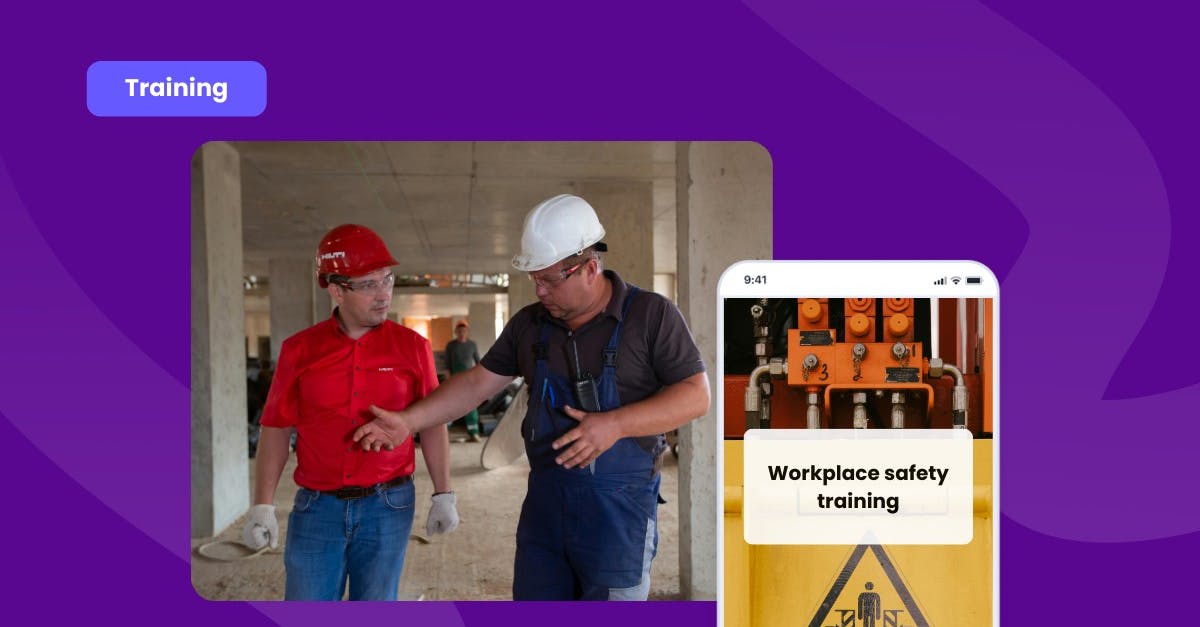
Considering that workplaces can come with all types of risks and hazards, it's crucial for employees to know how to keep themselves safe and comply with OSHA standards. If you're looking to create a safer work environment for your team, we've got some fantastic courses that can help get you started. The best part is, that these workplace safety training courses are customizable and readily available for you to share with your teams.
What is workplace safety training?
Workplace safety training is designed to help employees remain safe at work by minimizing accidents and improving compliance. It teaches them the best practices, risk assessments, and hazard prevention for their work environments, allowing teams to perform their roles securely.
Safety training for employees also gets your team ready for emergency response. It teaches them the right steps to take when dealing with injuries or damages, helping to minimize the impact of any crisis. This way, they can handle emergencies effectively, keeping everything as smooth and manageable as possible.
How important is safety training in the workplace?
Workplace safety training programs are essential for any organization because of the following reasons:
- Protects employees - Safety training helps your members avoid serious accidents by teaching them safe working techniques and effective risk management. This awareness protects them from injuries while they accomplish their tasks.
- Boosts regulation compliance - Employees must follow the health and safety requirements set by governing bodies. Workplace safety training helps your team to understand and apply these rules, allowing your organization to avoid costly penalties and incidents.
- Improves productivity - Safety training in the workplace teaches your crew the most efficient processes and practices that can improve productivity. By promoting safe operations, it reduces turnaround times and minimizes downtime from accidents, allowing teams to accomplish more.
1. New Hire Safety Orientation
SC Training (formerly EdApp), in partnership with Risk Management Inc., designed the New Hire Safety Orientation course to make workplace safety training a breeze for new employees during their induction. With 15 engaging lessons, it lays a solid groundwork for site safety and risk preparedness.


And that's not all. It even includes an action plan for emergencies and covers various types of employee safety training for specific situations, like using Personal Protective Equipment (PPE), electrical safety, and much more. It's like a one-stop shop for getting your team up to speed on safety.
Here, SC Training (formerly EdApp) uses nifty gamification features to make learning fun and engaging. It's a win-win situation because not only does it keep your workers entertained, but it also helps them remember everything they've learned.
The best part? All SC Training (formerly EdApp) courses are free for up to ten learners; it's the perfect training solution for small teams. You'll also have the option to upgrade to a paid plan with premium features or request a custom quote if you're planning to train more employees.
Get started with SC Training (formerly EdApp) for free and deliver top-notch workplace safety training courses!
2. Fire Safety
Do your employees know what to do in the event of a fire? This Fire Safety course provides a protocol for fire safety on the job. Since the courses are fully editable, you have the ability to easily tailor and include your workspaces’ particular layouts like photos, floorplans, and even working conditions.

This is also especially important in enclosed spaces where lockout tagout plans are also provided. The lessons provided here could be instrumental in saving someone’s life. With a useful acronym, trainees will understand how RACE is useful in responding to a fire.
3. Personal Protective Equipment (PPE) for Construction
Staying safe in the workplace requires knowing how to manage the risks associated with hazards like slips, and accidents. Knowing the right attire is equally important, and this is where the Proper Protective Equipment for Construction course shines.

While each business may have varying risks associated with this aspect of workplace safety, this course will provide some basic tips to help employees understand the significance of these potential hazards to avoid fatality.
4. Machine Guarding
Machine Guarding course is designed to arm you and your teams with employee safety and a vital safety program if you’re using machinery. Every industry has its own unique situations that present hazards and this course covers the most used machinery tools to help minimize risk and fatalities.

With relevant examples and key statistics such as the one shown below, employees will complete this course with vital safety-at-work takeaways to help maintain safety when using power tools.
5. Managing Risk
Contributed by Risk Factor in SC Training (formerly EdApp)’s editable course library, Managing Risk provides vital information about the risk management process which has undeniable benefits, including the power of implementing OSHA regulations from the start.

Trainees will receive important details about the scope, context, and criteria included in risk management. With this course, you can easily create a safety management system. Simply edit, brand, and personalize this course to fit your organization’s needs then deploy it to your teams within minutes.
6. Dealing with Difficult Customers
Safety in the workplace looks different in a bar versus a grocery store. Perhaps managing difficult situations and people isn’t the most obvious choice for safety management courses, but knowing how to Deal with Difficult Customers is equally valuable for safety culture.

Enable your teams with the knowledge on how to safely and confidently deal with any situation to minimize workplace violence, risk, and more. Like all the other courses with health and safety topics in this list, it’s free and fully editable.
7. Ladder Safety
Since ladders are found in retail spaces, construction worksites, and other industry settings, the Ladder Safety course is valuable for any workplace. This course details a pre-use check and other relevant safety issues that may otherwise go overlooked because they are simply not at the forefront.

Complete with relevant examples, this course can highlight the importance of workplace safety even in common situations that are all too often skipped. This training can also serve as a refresher, giving your teams a safety certificate online after completion.
8. Pallets, Racks, and Stacking Safety
The Pallets, Racks and, Stacking Safety course is a must for all workplace safety. With a focus on enforcing guidelines, inspections, and load limits, your teams will have a better understanding of the hazardous factors associated with this type of work.

Awareness is a key component of prevention and protection in the workplace and this editable course collection is relevant for a wide range of workplaces including warehouses, loading docks, retail, and more.
9. Dangerous Goods (Spill Training, Storage, Transportation)
The Dangerous Goods course is editable and ready for you to tailor to your needs. If you or your teams are exposed to chemicals in the workplace, they can have devastating effects and health implications if not handled properly.

Ensure your employees can confidently deal with chemicals by minimizing risk and knowing how to prevent toxic chemicals from entering their bodies. This detailed course covers storage, handling, and step-by-step checks.
10. Electrical Safety
The Electrical Safety course is perfect for any team to learn the basics. This course will teach your teams the difference in consideration between energized and de-energized work. Understand electrical circuits, lines, and systems and learn how to spot health hazards.

The Electrical Safety course also covers first aid and electrical accidents so that if a work-related emergency happens, it can be handled responsibly and calmly and in accordance with safety compliance.
11. Safety in the Workplace
This next course is a general health and safety training that teaches employees the safest ways to complete tasks and succeed in their roles. Safety in the Workplace equips your team with the essential skills and knowledge that protects them from the most common hazards at work.

They learn responsible practices like housekeeping and safeguarding, allowing them to avoid risks and maintain smooth operations. Overall, the course highlights how secure procedures boost productivity.
12. The Basics of First Aid
The Basics of First Aid course prepares your employees to handle common health emergencies that can happen at work. Knowledge and skills in first aid is a life-saving ability, because quick responses can reduce damages and recovery time.

Through this training, teams learn to properly assess and treat workplace injuries like burns, fractures, and wounds. The course also guides crews through more serious incidents like shocks and heart attacks. These lessons can help members go home healthy, no matter the issue.
Steps for an Effective Employee Safety Training Program
1. Identify pain points for employers and employees
Before anything else, you need to start by identifying your organization’s training requirements, particularly on workplace health and safety. What equipment are your teams handling in their day-to-day tasks? Where do common workplace injuries occur? What knowledge and skills do your employees need to have to accomplish their tasks?
After answering these questions, you need to identify your employee training needs. Are there gaps between their skills and the job requirements? Are there new skills and technical knowledge that they’re not equipped with? Is there an aspect of their behavior that needs to be changed? Is there internal data that you can use to identify more gaps?
Once pain points are identified, it’ll become easier to determine the goals and objectives of your training program
2. Determine goals and objectives
When making your employee safety programs, you need to decide on what you want to achieve from them. What would your workers get out of it? How does your company benefit from this? Determining your goals and objectives will also help you later assess whether the training was successful or not.
Objectives need to be well thought out and specific to the current needs for the training to be successful. They should be clear, concise, and measurable. Below are 4 elements to consider when developing your objectives:
- Audience: Identify who specifically is going to receive the training. Is this training relevant to them?
- Behavior: What changes can you expect in the team during the evaluation?
- Condition: Under what circumstances will the desired action be performed? What materials and equipment will be used?
- Degree/Standard: How well must a task be accomplished? What score must be achieved?
After determining these, consider how these objectives will help in the overall goals of the training. For example, if the goal is to receive a certificate of compliance afterward, the objectives must center around being able to pass the assessment and knowledge retention.
3. Develop training content and activities
Once you’re done identifying objectives and goals, the next question you need to ask is: how will you do that?
Different people have different learning needs. Some people learn better with more images and videos. Others would prefer reading materials to digest information. A good way to address the different learning needs is by providing different types of activities to engage each learner. Incorporating presentations, physical activities, gamification, and reading materials all in one training is how your program can become more holistic.
You can also choose to get microlearning lessons from learning management systems in case you don’t want to invest in seminar-type training. Microlearning lessons are quicker to finish and can usually be taken (or retaken) at any time you want. Learners won’t have to force themselves to digest a ton of information all in one go. Ideas and terms are given to you in bite-sized details to ensure maximum learning engagement. In case your team forgets some concepts or practices, they can always go back to these microlearning lessons anytime they want.
If you want to develop content yourself, you can ask for advice from team leads of your organization on how to best go about the training program. You could also ask a training and development consultant for input regarding your content.
4. Conduct and observe the training program
When plans are already polished and placed, all you need to do is execute them. Your starting point is to schedule everyone necessary for the training program. Ideally, the scheduling takes place months before the actual training so people can blot out the date early to concentrate on the program.
When the program properly starts, you need to onboard your workers with the objectives and goals of the training program. What do you want them to get out of this? This is to help align everyone and make sure that people see the value in conducting your new employee safety training program.
Once done, you can begin conducting the training. If you’re not a facilitator or if the training is happening on another platform, be a vigilant observer. Encourage questions and discussions during the training. Ask how they’re doing and if they have any current feedback. Help out when you see them struggling. Assisting them throughout the process can help with the success of the overall program.
5. Create an effective evaluation assessment
Once the training is complete, don’t forget to conduct a post-training assessment afterward. Evaluations are important to check whether the program was effective or not. They also serve as a benchmark for things to consider for the next training session. Assessments could be in the form of an examination or demonstration or a forum with the team.
Here are some questions you may want to consider during the assessment process: How did the team feel about the training? What areas or aspects of the program could have been better? How much of the knowledge and skills did your workers retain?
When enough time has passed, you can circle back to the team leads or your HR/legal team to ask them if the training they did weeks or months back has reduced workplace injuries and accidents. If the answer is yes, you won’t have to immediately do another training round.
If not, go back to the feedback from the employees and review certain aspects of the training program – which you personally think could have been done better. Check the discussion minutes during the post-training assessment forum. What are the common complaints from the team? What are their suggestions to improve on the current program? What do they want you to do in the future?
You may want to reinforce your team’s training or conduct a different series of learning for next time.
Other free course lists
Author